 VOSySofficial



Virtualization of Application Software Stacks to Lower TCO Costs
Virtualization of a MultiMedia Box Software Stack Using QEMU/KVM and VFIO on ARMv8 Platforms

Virtual Open Systems enables the abstraction of a complete MultiMedia Box (MMB) software stack by implementing an MMB virtualization layer. Moving MMB core functionalities within Virtual Machines (VM) greatly improves the maintainability of the system, simplifies its future migration to new hardware platforms, thus lowering the total cost of production and ownership (TCP, TCO), the cost of maintenance and software updates, while enhancing the overall security.
Same benefits can be obtained by transposing the same architecture to other use cases in different market segments such as, for instance, industrial, automotive and IoT.
The concept showcased in this video demonstration consists of two KVM virtual machines running on an ARMv8 platform, based on a multicore heterogeneous multimedia SoC. High performance is guaranteed by the usage of the device pass-through technique, which exposes some key multimedia devices to guest systems, allowing the virtual machine to have a full control of the display and the GPU at nearly a native performance; for instance, from within the VM it's possible to decode 4K video streams displayed on a 4K monitor.
Such a high performance implementation has been achieved by heavily modifying QEMU and VFIO to overcome limitations of their respective upstream code that prevented an efficient pass-through of the devices.
The overall virtualized MMB system architecture, as depicted in the following illustration, foresees two virtual machines (VM1 and VM2), VM2 providing all the networking functionalities to VM1 which instead implements the multimedia functionalities.
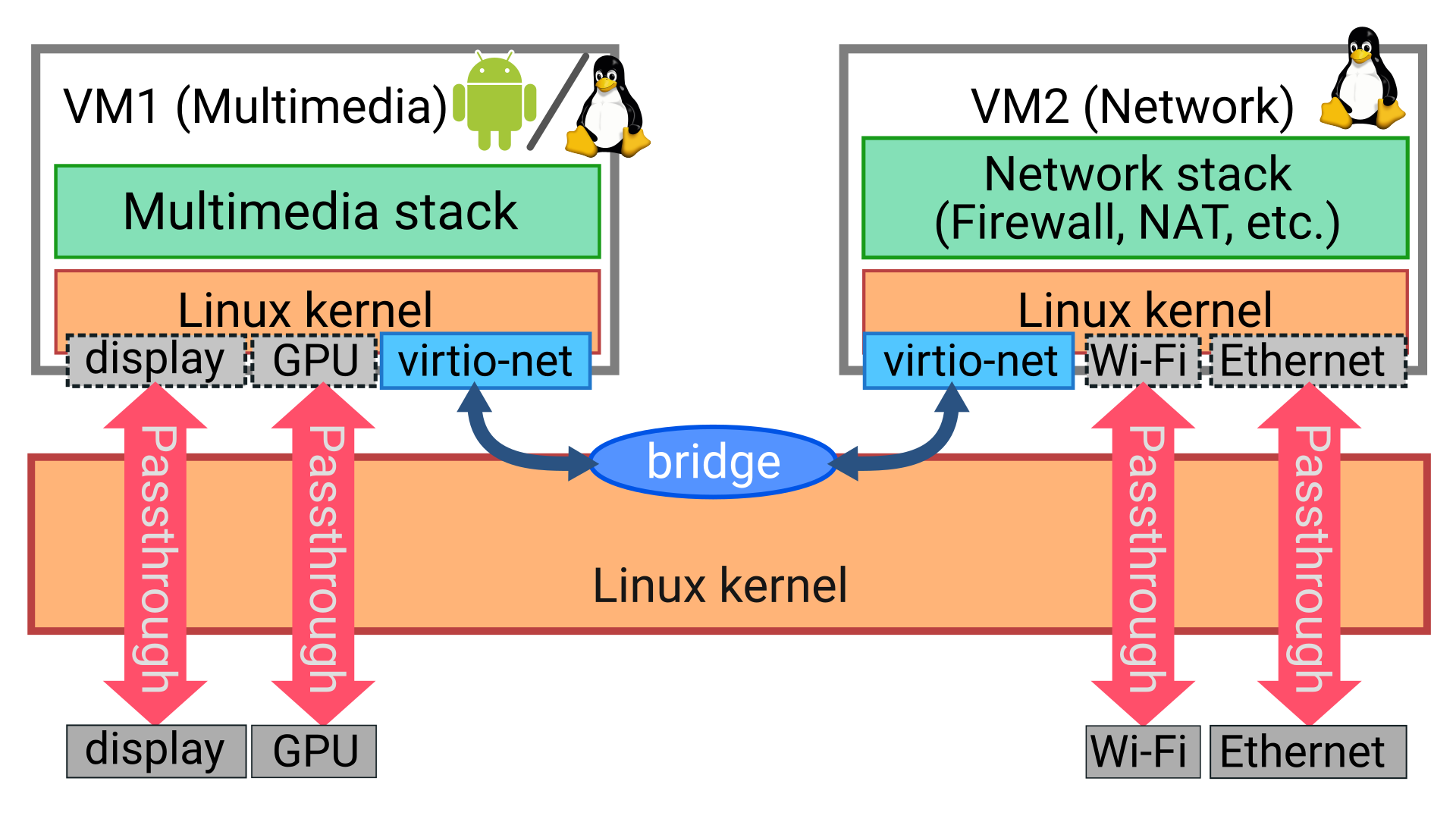
Virtualized MultiMedia box: system architecture preserving high performance, lowering TCO
VM1 has full control of the display and also pilots the remote control which can be used by the user to navigate the UI user interface. In VM1, for the purpose of the demonstration, two operating systems are supported, one is a Linux distribution featuring a custom set-top box interface, while the second is Android TV.
In this video demonstration the following multimedia virtualized streaming functionalities are showcased:
- Display of 4K video content from media files
- Display of 4K video streaming from a satellite DVB-S tuner
- Display of 4K video streaming from YouTube
- 3D OpenGL rendering
With this demonstration, Virtual Open Systems on one side exposes once more its rare-to-find know-how and products to integrate virtualization technologies in new market segments spanning from multimedia consumer gateway to Industrial IoT, through embedded systems up to mixed-critical Automotive; on the other side advocates the huge TCO and maintenance cost savings which can be achieved in these market segments by a competent usage of virtualization technologies, as they can be served and provided by Virtual Open Systems.
- Kvm on arndale exynos
- Kvm armv7 multiple guests poc
- Kvm full virtualization on vexpress
- Kvm vs tcg virtualized guests
- Byod android kvm on cortex-a15
- Kvm android guest on arm fastmodels
- Vosyshmem api remoting
- Virtual bfq in action
- Vosyswitch perf openstack integration
- Vosyswitch odp armv8
- Kvm virtualization training video
- Vosysmonitor secure freertos optee linux
- Vosyswitch interop
- Vosysmonitor als2016
- Vosysmonitor als2017
- Vosyswitch interop2017 shownet arm server
- Memguard memtalk kvm armv8
- Vosysiot sido demo
- Vosysmonitor mt2712 jp 日本語
- Vosysmcs rcar forum 2018
- Vosysmonitor emcos ew2019 jp 日本語
- Vfpgamanager sdnnfv2018
- Vosysiot edge iotwc2018
- Vosysmonitorx86 demo
- Vosysmonitor emcos ew2019
- Virtualizing fpga accelerators
- Vosysmonitor mt2712
- Vosysmonitorv risc v demo
- Vosysmonitorv core sharing virtualization demo
- Virtio loopback agl lf
- Virtio loopback agl lf alpha release
- Everest virtio fpga
- Risc v multiple os
- Virtio loopback sound agl
- Wave fpga sriov
- Vmanager nancy outcome
- K8s svff satcom wave